
Features · Vocabulary for everyday life
Follow a word beyond its definition.
Etymology asks where a word came from and how it reached its current form. Neologics puts word origins beside meaning and usage so that discovering a new word can also reveal part of its story.
Use a word’s history as another way to understand it, then check its present-day meaning and examples. Origins provide context; they do not determine how a word must be used today.
Read the meaning and the story together
A dictionary definition helps with the sense of a word. Its origin may add a connection to a familiar root, an earlier language, or an older use. In Neologics, that context sits alongside examples, pronunciation, and other learning material.
The depth of a word’s history varies. Some accounts are well established, while others contain uncertainty. Not every English word has the same ancestry, and a single route through ancient languages should not be presented as the history of every word.
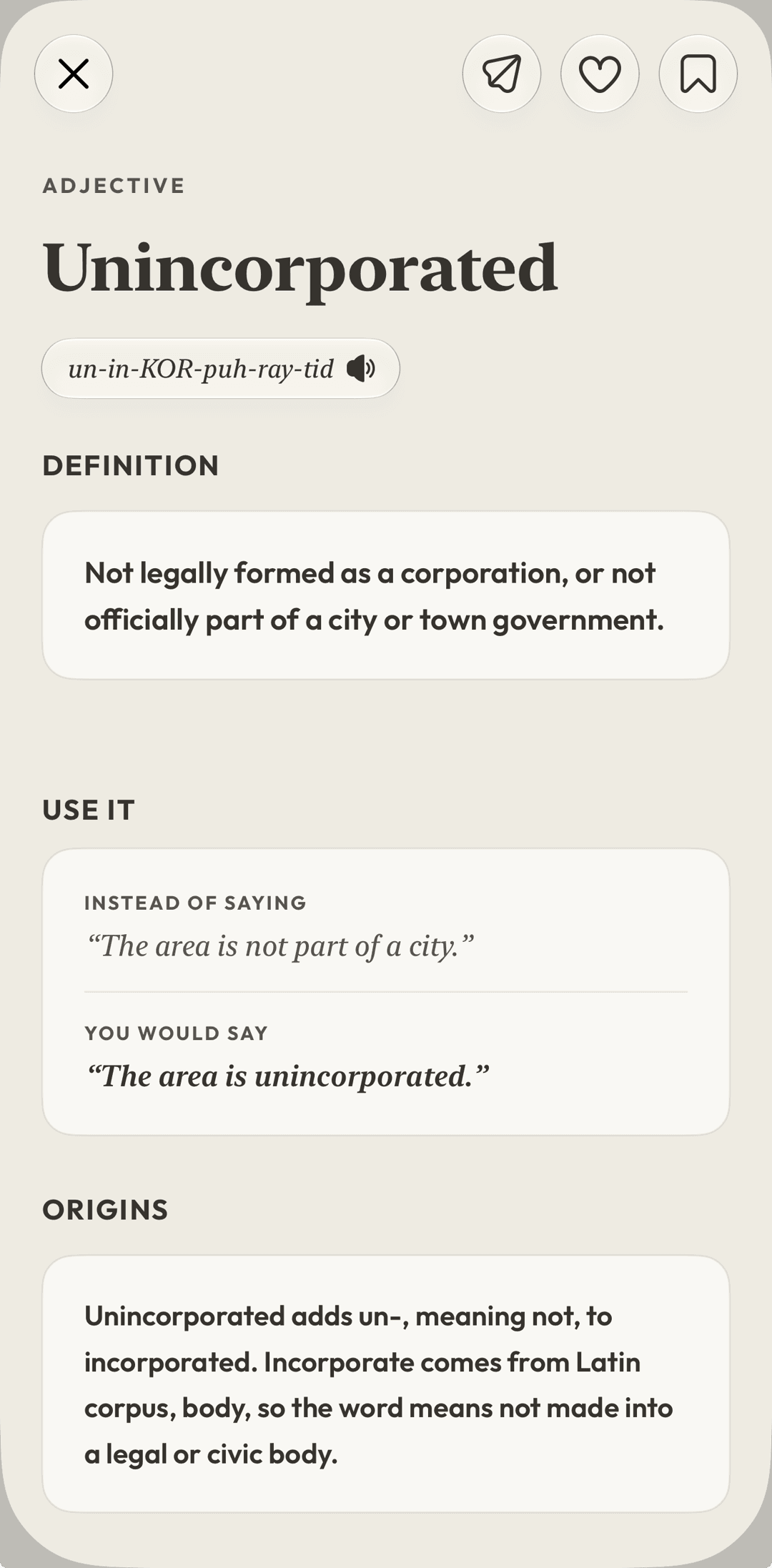
A word’s origin is not its entire meaning
Words change as people use them. An origin can help explain how a form developed without telling you every current sense, tone, or grammatical pattern. Start with the meaning that fits the sentence you are reading, then explore the historical connection.
This matters when learning words for your own writing. A clever connection to a root can be memorable, but a natural example tells you more about how the word works in a sentence today. Use both kinds of context and avoid treating an origin as a rule that overrides current usage.
Turn curiosity into a vocabulary routine
When an origin interests you, pause before moving to the next word. Explain the current meaning in plain language and write a sentence of your own. If the historical detail helps you remember the word, add it to your mental explanation; if it distracts you, keep the simpler example.
- Read the definition and identify the sense used in the example.
- Explore the origin and notice any connection that is useful to you.
- Listen to the pronunciation and say the word in context.
- Write a sentence that shows the present-day meaning.
- Return to the word later and attempt recall before rereading.
Choosing an app for word origins
If word history is your main interest, examine how clearly an app separates established information from uncertainty and how easy it is to move between origin and present meaning. Check whether explanations support the kind of reading you actually do.
Neologics combines origins with a daily vocabulary routine on iPhone. Vocabulary by Monkey Taps also advertises word origins, so this feature should not be treated as exclusive to Neologics. Compare the explanation of a word you know, then an unfamiliar one.
Sources: Neologics on the App Store (opens in a new tab) · Vocabulary on the App Store (opens in a new tab)
Keep using the words you discover
It is easy to enjoy a word’s story and still never use the word. Make the next step practical: explain it to someone, recognize it in your reading, or include it in a sentence where it fits. Personal vocabulary can hold words you want to return to.
Download Neologics to explore word content and practice on iPhone. Optional Pro access and current feature limits are shown in the app. For historical research that requires citations to original texts, consult specialist reference works as well as a learning app.
Try it with a word that matters to you
Your next word starts here.
Explore daily words, origins, and personal vocabulary with Neologics for iPhone.
Free to download. Optional Pro access. Read the FAQ or contact support.